
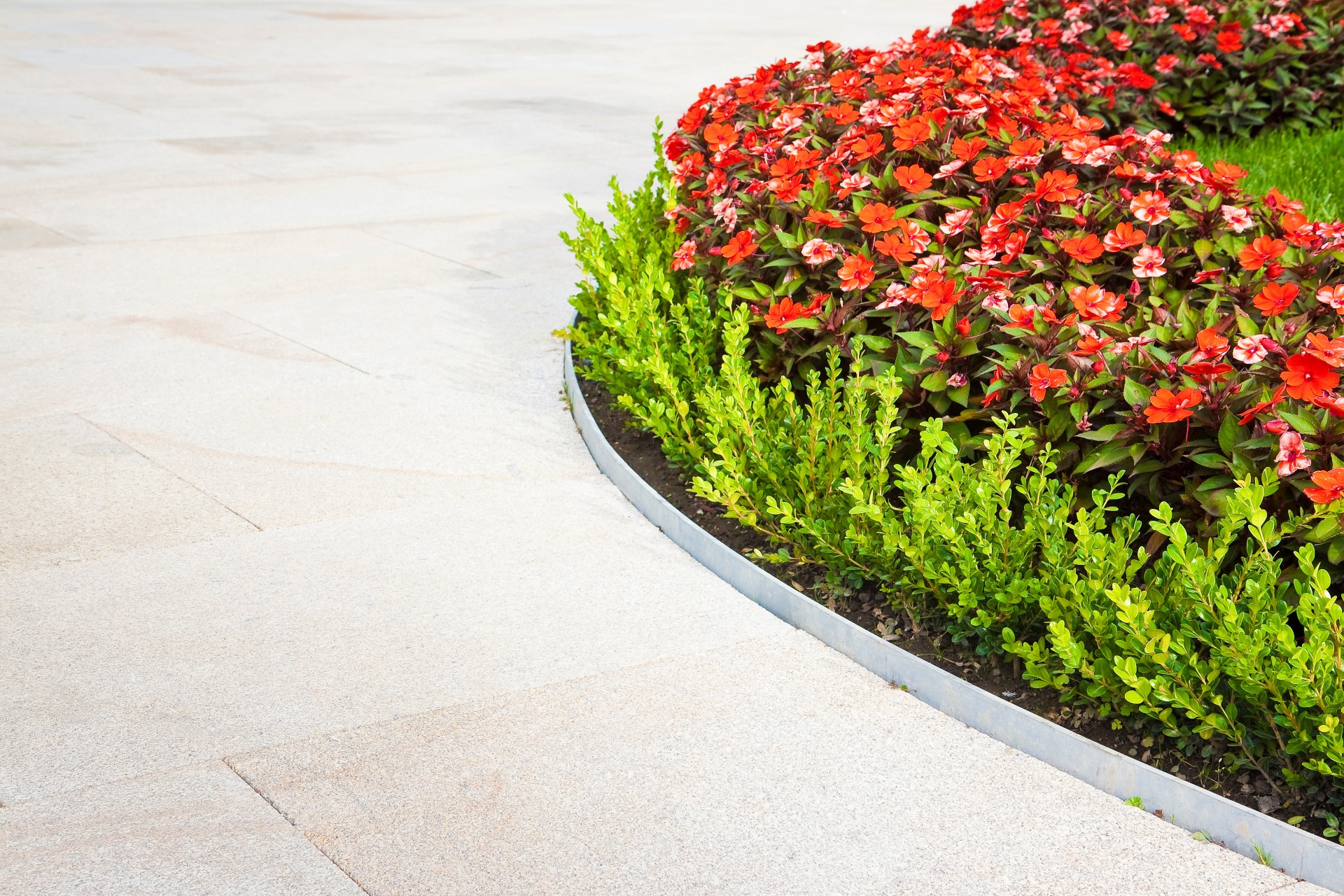
When homeowners shop for landscape edging, the choice often comes down to two options: concrete or plastic. Both serve the same purpose, but they perform very differently once exposed to years of weather, mowing, and soil movement. Understanding how each material actually behaves over time makes it easier to choose the right solution from the start rather than revisiting the decision a few seasons later.
How Plastic Edging Performs Over Time
Plastic edging is widely available and installs quickly, which makes it a common first choice. In the short term, it does the job. The issues tend to surface after the first full year in the ground.
Freeze-thaw cycles cause plastic to become brittle. UV exposure leads to fading, warping, and surface cracking. The stakes that anchor plastic edging into soil shift with frost heave, creating gaps and uneven sections along what was once a clean border. What started as a one-time installation becomes a recurring maintenance task as sections are pulled up, reset, or replaced season after season.
How Concrete Edging Performs Over Time
Concrete edging is poured on-site as a single continuous piece, which removes the joints and connection points where most edging systems begin to fail. Fiber and steel cable reinforcement prevent cracking and heaving through repeated freeze-thaw cycles. A proper sealing schedule protects both color and surface integrity long after installation.
Because it is sealed, concrete edging does not respond to UV exposure the way plastic does. It holds its shape, holds its position, and holds its appearance without the annual attention that temporary materials demand.
Beyond Longevity: Why Stability Matters Day to Day
Durability gets most of the attention in edging comparisons, but the day-to-day functional benefits are just as important to homeowners. A stable, continuous border keeps mulch inside beds where it belongs and prevents grass from creeping into garden areas over time. It also creates a cleaner mowing edge, which speeds up lawn maintenance and reduces the trimming required along bed lines.
When edging shifts or degrades, those functional benefits disappear alongside the appearance. Mulch migrates, grass encroaches, and mowing lines become uneven. A border that holds its position maintains those practical advantages every season.
The True Cost of Landscape Edging
Homeowners often compare installation costs without accounting for replacement cycles. Plastic edging carries a lower upfront price, but that advantage narrows quickly when material and labor costs for periodic reinstallation are factored in. An edging system that needs attention every few years can ultimately cost more than a permanent solution that remains in place for decades.
Concrete edging costs more at the point of installation. Spread across its service life, however, that cost per year drops well below what repeated replacement cycles add up to over the same period.
Which One Actually Lasts Longer?
Plastic edging is a short-term solution. It works until the conditions it was never designed to handle permanently catch up with it. Concrete edging is installed once, sealed on schedule, and built to perform through every season without the cycle of replacement that temporary materials require.
For homeowners who want a border that looks clean, holds its position, and keeps working year after year, the comparison comes down to one install versus many.
If you are ready to invest in a landscape border built for long-term performance, at Pioneer Curb & Borders, our reinforced, sealed concrete curbing is designed to withstand seasonal conditions while maintaining a clean, finished appearance. Contact us today for a free quote.